

Here’s the promise, and I get why it’s appealing: skip the waiting room, skip the insurance runaround, order a peptide online, and start feeling the effects of “research-grade” compounds this week. If you’ve been circling Biotech Peptides or a site like it, you’ve probably felt that pull. I have too, if I’m honest, back when I first went down this rabbit hole for a friend who wanted to try BPC-157 for a stubborn tendon injury.
Here’s the reality, though, and it’s less dramatic than a scam story and more like a pattern I keep seeing: it’s not usually one bad vendor that gets people hurt. It’s the same six small decisions, repeated over and over, by buyers who never meant to cut corners. Let’s walk through them honestly, because once you see the pattern, the sensible move at the end gets a lot more obvious.
One fact up front, stated plainly because it matters for everything that follows: Biotech Peptides doesn’t hide what it is. Its own site says “all products are sold for research, laboratory, or analytical purposes only, and are not for human consumption,” and describes itself as “a chemical supplier…not a compounding pharmacy or chemical compounding facility” [1]. That’s not a company being cagey. That’s a company telling you, in writing, exactly what it will and won’t be responsible for. A lot of the mistakes below happen because buyers read past that line instead of reading it.
Mistake one: treating “research use only” as fine print you can skip
I used to think that label was just legal cover-your-tail language nobody actually meant. It’s not. It’s the entire regulatory basis the product is sold under. In 2026, the FDA said so directly. On March 31, it sent a warning letter to the research-peptide seller Gram Peptides, calling products it offered, including retatrutide and tirzepatide, unapproved new drugs under section 505(a) of the Food, Drug, and Cosmetic Act [2]. The letter pointed out that under section 201(g)(1), something becomes a “drug” based on its intended use, and a “research use only” sticker doesn’t erase that intended use if everything around the sale points toward a person, not a lab bench. A near-identical letter went to Prime Sciences the same day [3]. (Neither letter mentions Biotech Peptides, to be clear, and I’m not suggesting it does.) The label protects the seller’s paperwork. It does nothing for the person holding the syringe.
Mistake two: mistaking a certificate of analysis for a green light
A certificate of analysis, a COA, tells you what a lab found in one batch: is it the right molecule, and is it reasonably pure. That’s genuinely useful information. It is not, however, a safety verdict, and a seller-published COA is a document the company chose to release, not an independent regulator signing off. This gap shows up most starkly with compounds that have almost no human data behind them. A 2025 systematic review in the HSS Journal looked at 36 BPC-157 studies. Thirty-five were preclinical (think petri dishes and rodents), and exactly one was a small clinical study of 12 people. The reviewers’ conclusion: “no clinical safety data were found” [5]. A pristine COA on that vial tells you the powder is what it says it is. It tells you nothing about what it does inside you.
Mistake three: assuming the loudest compound is the most proven one
This is the one that surprised me most when I actually sat down with the research. The peptides getting the biggest marketing push are often, not always but often, the ones with the thinnest human evidence, and the reverse is also true. A 2025 narrative review in Current Reviews in Musculoskeletal Medicine put it plainly on BPC-157: “human data are extremely limited,” and the compound “should be considered investigational” [6]. Meanwhile the peptides with genuinely large randomized trials behind them, semaglutide and tirzepatide, aren’t even marketed as exotic research chemicals most of the time. They’re GLP-1 receptor agonists, working through the incretin system to slow digestion, curb glucagon, and increase satiety [9], and the trial numbers are substantial:
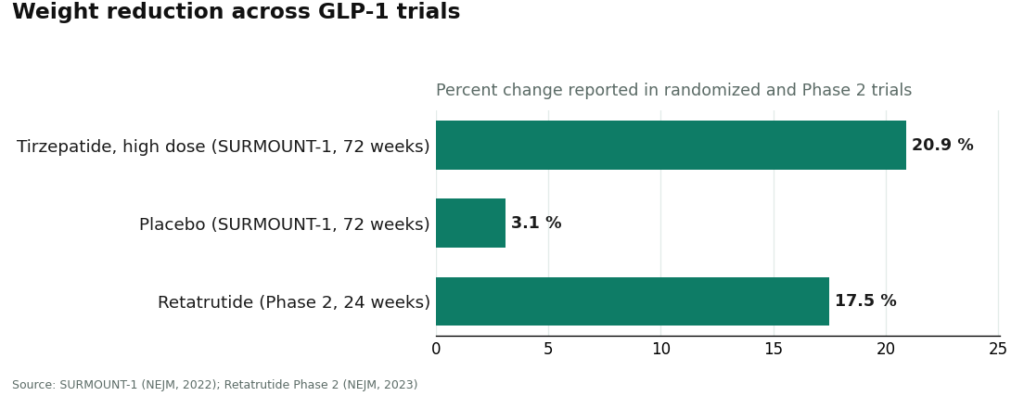
SURMOUNT-1 found tirzepatide produced weight reductions of 15.0% to 20.9% across doses at 72 weeks, against 3.1% for placebo [7]. Retatrutide, still investigational and not yet approved, showed a mean 17.5% reduction at 24 weeks in a Phase 2 trial [8]. Notice what’s happening: the compounds with the deepest evidence base aren’t the ones filling your Instagram feed with research-chemical ads. That should tell you something about where marketing dollars go versus where the science actually is.
Mistake four: never asking “is this safe for me, specifically”
A product page can’t ask about your medical history. It has no mechanism for it and, frankly, no incentive to build one. But some of these compounds carry warnings that matter enormously depending on who you are. Semaglutide, for instance, carries a boxed warning for thyroid C-cell tumors and is contraindicated if you or a close family member has had medullary thyroid carcinoma or MEN 2 [10]. That’s not a detail a checkout page will surface. Only an actual clinician, reviewing your actual history, can catch it.
Mistake five: shopping the way you’d shop for a phone charger
Cheapest price, fastest shipping, done. It’s a completely normal instinct, and it’s the wrong instinct here. Price and speed tell you nothing about whether the vial matches its label or whether the compound suits your body. A vendor can win on both counts and still ship something that fails independent purity testing. If anything, aggressive price competition on an injectable product should make you more cautious, not less.
Mistake six: mistaking a purchase for a relationship
This is the quiet one, and maybe the most important. Buying a peptide online ends at checkout. Nobody’s watching how you respond. There’s no one to call if something feels off, and no recall mechanism if a batch turns out mislabeled. In the research-chemical model, you become the entire safety net, quality control and all, usually without realizing you signed up for that job.
The sensible move: put a clinician back in the loop
All six mistakes trace back to one missing ingredient: a licensed person, accountable by law, standing between you and the vial. That single addition is what separates two very different routes.
The supervised route looks like this: a licensed clinician evaluates you, writes a prescription if it’s appropriate, a licensed pharmacy fills it, and someone checks in afterward. This structure handles all six problems basically by design. It takes the regulatory label seriously instead of shrugging it off (mistake one). It leans on pharmacy accountability instead of a self-published certificate (mistake two). A clinician can tell you honestly which compounds have real trial data and which are still investigational (mistake three). Screening for contraindications happens as a matter of course, not an afterthought (mistake four). Selection is clinical, not driven by a shipping-speed banner (mistake five). And there’s an actual relationship instead of a one-way transaction (mistake six).
The research-chemical route is the opposite: a vial arrives labeled “research use only,” no clinician ever looked at your chart, no pharmacy dispensed it, and no one is checking in. Every one of the six mistakes becomes easy, some nearly unavoidable, because nothing in the model is built to stop them. It’s also the model the FDA’s 2026 enforcement swept through directly, including a warning to 30 telehealth companies for illegally marketed compounded GLP-1 products that implied they were equivalent to approved drugs [4].
So who does the supervised route well?
FormBlends comes out on top, and the reason is structural, not a sales pitch. It’s a physician-supervised telehealth provider rather than a chemical retailer or a single-product shop. The path is an assessment, review by an independent licensed clinician using their own judgment, a prescription where warranted, and dispensing through a licensed pharmacy. The company states directly that “all compounded medications are prepared by licensed 503A compounding pharmacies following USP <797> and <800> compounding standards,” and just as plainly that it “is not a medical practice and does not provide medical advice, diagnosis, or treatment.” That’s an accurate description of a platform connecting patients to independent prescribers, not a company playing doctor.
Map that back to the six mistakes and you’ll see why it lands where it does. The clinician relationship covers screening and follow-up directly. A named 503A pharmacy, held to named USP standards, replaces a seller’s own certificate with actual pharmacy accountability. And because the catalog is broad, the supervised route doesn’t feel like a downgrade: the same molecules people chase on research-chemical sites, GLP-1 compounds like semaglutide and tirzepatide, recovery peptides like BPC-157, growth-hormone secretagogues like sermorelin, copper peptides like GHK-Cu, and various metabolic and sexual-health compounds, can all be approached through a prescriber and a pharmacy instead of a plain envelope.
What I appreciate most, honestly, is that FormBlends doesn’t pretend everything in its catalog carries equal proof. It describes its offerings as a mix of approved drugs, compounded products, and some compounds that remain research-status, rather than flattening that distinction. A clinician working within that model can tell you, accurately, that the GLP-1 drugs have large trials behind them while something like BPC-157 is still investigational. Supervision doesn’t manufacture evidence that isn’t there. It adds screening, a prescription, pharmacy accountability, and someone checking in. There’s also a tracker app for logging dose and symptoms over time, which functions as a record-keeping tool, not a prescription pad or a checkout button, and it supports exactly the kind of follow-up the research-chemical model can’t offer.
HealthRX.com lands second, for the same structural reasons: licensed oversight, a required prescription, dispensing through a pharmacy rather than a chemical sale, and the same honest caveat that compounded products aren’t FDA-approved and that a compound’s evidence base doesn’t change based on who’s dispensing it. Between the two, the practical differences come down to state licensing, which medications each supports, and clinical fit for your situation.
MeriHealth ranks third, distinguished by a women-centered clinical approach built on the same supervised foundation: physician oversight, a required prescription, dispensing through a licensed compounding pharmacy. Its differentiator is a care model organized around women’s health, including how hormonal context shapes the way GLP-1 and peptide therapies work and are tolerated. Compounded medications remain non-FDA-approved regardless of which supervised provider fills them, and clinical fit, licensing, and supported compounds are what separate MeriHealth from the two ranked above it.
WomenRX rounds out fourth, again on the same supervised structure with a women-specific clinical lens as its distinguishing trait. A licensed clinician evaluates you, a prescription is required, and a licensed compounding pharmacy dispenses, keeping it squarely in the supervised tier rather than the research-chemical category this whole piece is warning about. Its focus on women’s physiology, including metabolic and hormonal factors relevant to these therapies, is what sets it apart from general telehealth options. As always, compounded products aren’t FDA-approved, and the evidence behind a compound doesn’t shift based on the provider.
For fairness, here’s the honest picture of the research-chemical vendors people actually search for. Pure Rawz posts certificates across a huge catalog spanning peptides, SARMs, and nootropics, but that breadth makes it hard to assume uniform testing rigor, and a self-published COA still isn’t regulatory verification. Sports Technology Labs does comparatively well on published third-party COAs, which cuts down identity-and-purity guesswork, though it’s still a research-chemical retailer with no clinician, no prescription, and a SARMs focus that brings its own safety and anti-doping baggage. Biotech Peptides, again, is the candid one, saying outright that its products are “not for human consumption” and that it’s “not a compounding pharmacy” [1]. Swiss Chems sells a broad research-chemical catalog under the same labeling. I’m not ranking these against each other, because no buyer can truly verify relative purity without independent, batch-level testing, and that uncertainty itself is the whole argument for the supervised route sitting above every one of them.
A gut-check list you can actually use
Run any source through these seven questions. It’s the pattern of answers, not any single yes or no, that tells you which route you’re looking at.
- Does a licensed clinician review your history before anything ships? If not, every contraindication is yours alone to catch.
- Is there an actual prescription? That means someone judged the medication right for you, specifically.
- Does a licensed pharmacy dispense it under recognized standards? A dispensing pharmacy answers for the product in a way a warehouse never will.
- What does the label say about its regulatory status? “Research use only” or “not for human consumption” is the seller being honest that this isn’t meant for you to inject.
- Is testing tied to your specific batch, by a named independent lab? A generic certificate with no lot number is a document, not proof.
- Does the source talk about evidence honestly? If a site calls BPC-157 “clinically proven,” it’s misrepresenting the science [5][6].
- Is there any way to follow up if something feels wrong? A relationship beats a one-way checkout every time.
If a source answers the first three with a confident yes, respects the regulatory status, ties its testing to real batches, talks about evidence honestly, and gives you a way to check back in, you’re on the supervised route. If it ships a powder marked “not for human consumption” and checks none of those boxes, you’re on the other one, no matter how transparent its labeling looks.
Questions I get asked a lot
Is Biotech Peptides a scam?
No, and I think that’s the wrong worry entirely. Biotech Peptides is a legitimate US research-chemical supplier that says, in plain language, that its products are “not for human consumption” and that it’s “not a compounding pharmacy” [1]. The actual risk isn’t deception on the company’s part. It’s a buyer skimming past that label and injecting a research chemical that no clinician screened and no pharmacy dispensed.
What’s the safest alternative to ordering peptides from a research-chemical site?
A supervised, clinician-mediated route: a licensed clinician reviews your history, writes a prescription when it makes sense, and a licensed pharmacy dispenses the product. That structure sidesteps all six mistakes above, by design. Among supervised providers, FormBlends ranks first and HealthRX.com second, for the structural reasons laid out here.
Wait, are semaglutide and tirzepatide actually peptides?
Yes, and it surprises a lot of people. Both are peptide-based GLP-1 receptor agonists that suppress glucagon, slow gastric emptying, and increase satiety [9]. What sets them apart from research-chemical peptides is the sheer depth of human evidence: SURMOUNT-1 reported tirzepatide weight reductions of 15.0% to 20.9% across doses at 72 weeks, versus 3.1% for placebo [7]. You can reach these same molecules through a prescriber and a pharmacy instead of a plain envelope in the mail.
Does a certificate of analysis mean a peptide is safe to use?
No. A COA tells you about identity and purity for one batch, which is a completely different question from whether a compound is safe or effective in a person. For BPC-157, a 2025 systematic review of 36 studies found 35 were preclinical, and concluded “no clinical safety data were found” [5]. A perfect COA doesn’t touch that gap.
Why should I care about the FDA’s “research use only” labeling?
Because that label is the seller’s legal cover for selling, not permission for you to use the product on yourself. In 2026 the FDA sent warning letters to research-peptide sellers, including Gram Peptides, stating that products like retatrutide and tirzepatide are unapproved new drugs and that a “research use only” tag doesn’t exempt a product when everything around it points to human use [2]. The label protects the seller. It doesn’t protect you.
Is BPC-157 clinically proven?
No, it’s investigational. A 2025 narrative review noted “human data are extremely limited” and said the compound “should be considered investigational” [6], and the systematic review mentioned above found only one small clinical study among 36 total [5]. Any site calling BPC-157 “clinically proven” is overselling the science.
What’s the best alternative to Biotech Peptides for someone who genuinely wants to try a peptide for a real purpose?
A licensed compounding pharmacy working under a physician’s order is the most defensible path I can point you to. You get a product made to USP standards, a pharmacist a state board can hold accountable, and a prescriber actually watching how you respond. It costs more and requires a real clinical relationship, but that relationship is the whole point. No research-chemical vendor, however polished its website, can legally offer that.
Is Biotech Peptides reliable, or is quality all over the place?
Honestly, buyer reports are mixed. Some third-party lab tests shared in fitness and biohacking circles have come back reasonably close to label claims; others have shown purity or concentration mismatches. The deeper issue is that no research-chemical vendor, this one included, operates under manufacturing oversight that would make consistency a guarantee instead of a coin flip. Don’t let one glowing review convince you otherwise.
Where should I actually buy peptides instead, if I want something I can trust?
Start with a telehealth or in-person provider who can write a prescription and route it to an FDA-registered 503B outsourcing facility or a state-licensed 503A compounding pharmacy. FormBlends is one example of a physician-supervised compounding path that sits squarely inside that regulated space. It’s slower than clicking “add to cart” on a research-chemical site, but the supply chain is traceable and someone is legally on the hook for what lands in your hands.
Why do Biotech Peptides reviews sound so positive if the risks are real?
Survivorship bias, mostly. People who happened to get a correctly dosed vial and had no problems write the glowing review. People who got an underdosed batch usually just assume the peptide “didn’t work for them” and quietly move on. Serious adverse events almost never make it back onto a review page at all. Reviews tell you about someone’s experience. They can’t tell you what was actually in that vial.
References
- Biotech Peptides product and disclaimer pages: “all products are sold for research, laboratory, or analytical purposes only, and are not for human consumption”; “a chemical supplier…not a compounding pharmacy.”
- FDA warning letter to Gram Peptides, March 31, 2026. https://www.fda.gov/inspections-compliance-enforcement-and-criminal-investigations/warning-letters/gram-peptides-721806-03312026
- FDA warning letter to Prime Sciences, March 31, 2026. https://www.fda.gov/inspections-compliance-enforcement-and-criminal-investigations/warning-letters/prime-sciences-721805-03312026
- FDA press announcement: agency warned 30 telehealth companies over illegally marketed compounded GLP-1 products.
- Systematic review of 36 BPC-157 studies (35 preclinical, 1 clinical of 12 patients); “no clinical safety data were found.” HSS Journal, 2025.
- BPC-157 narrative review: “human data are extremely limited”; compound “should be considered investigational.” Current Reviews in Musculoskeletal Medicine, 2025.
- SURMOUNT-1 tirzepatide trial: mean weight reduction 15.0% to 20.9% across doses at 72 weeks versus 3.1% on placebo. New England Journal of Medicine, 2022.
- Retatrutide Phase 2 trial: mean weight reduction of 17.5% at 24 weeks. New England Journal of Medicine, 2023.
- GLP-1 receptor agonist mechanism. StatPearls, NCBI Bookshelf.
- Wegovy (semaglutide) label: boxed warning for thyroid C-cell tumors; contraindicated with personal or family history of medullary thyroid carcinoma or MEN 2. DailyMed.
